

30 Years of NewTom: The Story of a Revolution That Rewrote the Future of CBCT Technology
30 Years of NewTom: The Future of CBCT Technology
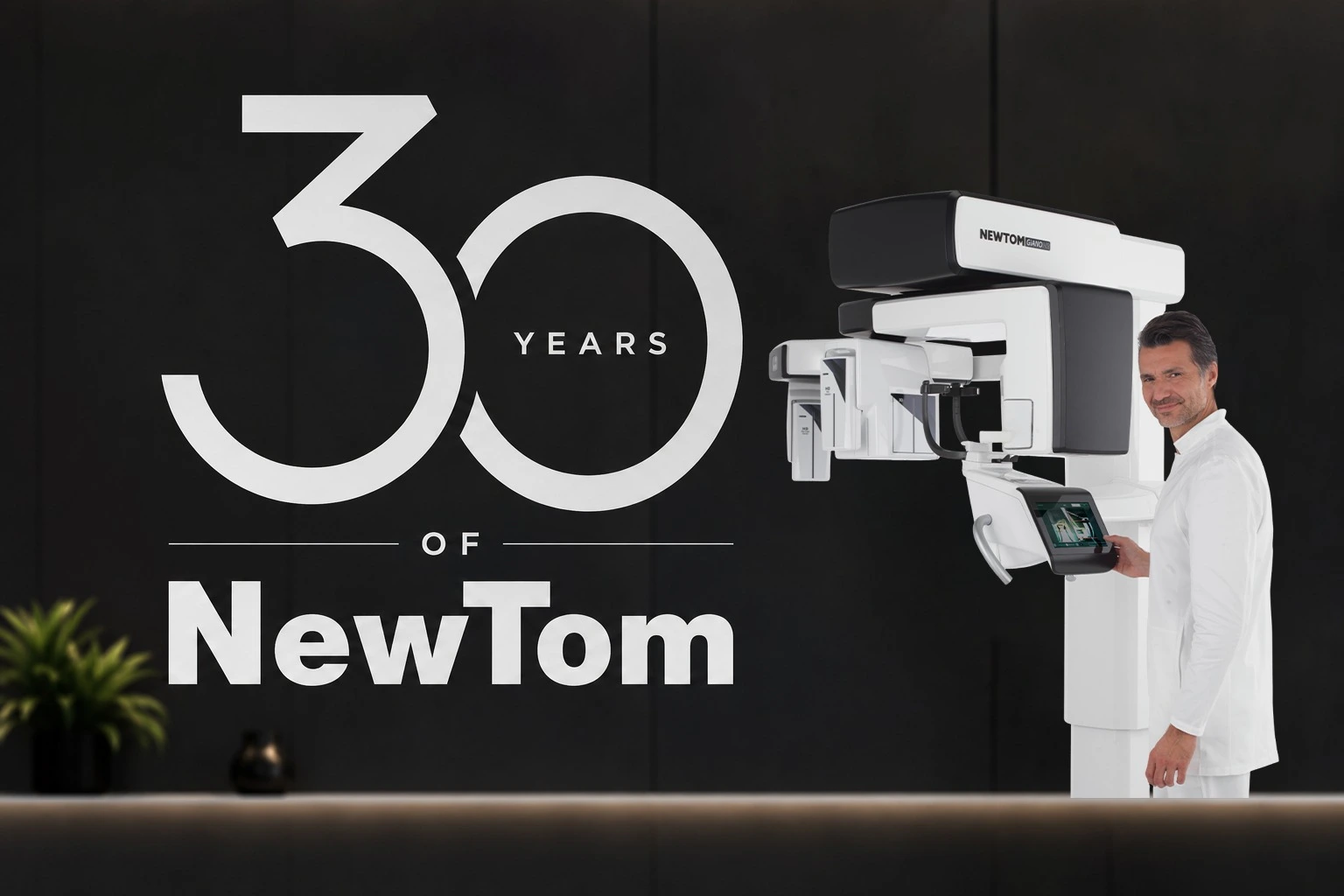


There are moments in the history of medicine when a single invention changes everything. The invention of the stethoscope changed how physicians listened. The discovery of X-rays changed how they looked. And in 1996, in a laboratory in Verona, Italy, a small team of four visionary scientists changed how the dental world sees – forever. This is the story of 30 years of NewTom: thirty years of a revolution that gave birth to the world’s first dental CBCT machine, and never stopped pushing the boundaries of what diagnostic imaging can achieve.
In 2026, as we celebrate this remarkable milestone, it is worth taking a step back from the cutting-edge technology of today to understand where it all began – and why the journey of NewTom CBCT technology is one of the most extraordinary stories in the history of modern dentistry
In 1996, four Italian scientists invented a technology that would transform dental diagnosis worldwide. Thirty years later, that revolution continues.
1996: The Big Bang of Dental CBCT Technology
The story of 30 years of NewTom begins in Verona, Italy, at a company then known as QR – Quantitative Radiology. Four Italian imaging experts – driven by equal parts scientific rigour and bold ambition – set out to solve one of dentistry’s most persistent diagnostic limitations: the inability to see the oral anatomy in three dimensions with a safe, accessible, and affordable technology.
The Birth of the NEWTOM 9000
In 1996, they succeeded. The result was the NEWTOM 9000 – the world’s first Cone Beam Computed Tomography (CBCT) machine designed specifically for clinical dental applications. This was not an adaptation of an existing medical CT scanner. It was a purpose-built dental CBCT machine – designed from the ground up for the oral and maxillofacial anatomy, with patient safety, clinical workflow, and diagnostic accuracy at its core.
The CBCT technology behind the NewTom 9000 used a cone-shaped X-ray beam and a two-dimensional flat panel detector to capture an entire anatomical volume in a single rotation around the patient. The radiation dose was reduced by at least five times compared to traditional medical CT scanners. The image quality was diagnostic. The clinical applications were immediately transformative. And the impact on global dental imaging solutions was, without exaggeration, revolutionary.
Why CBCT Technology Changed Dentistry Forever
Before the NewTom CBCT machine, dentists and oral surgeons relied exclusively on 2D radiographic images – flat projections that compressed complex three-dimensional anatomy into a single plane. Implant planning was educated guesswork. Root canal morphology was limited to what a periapical X-ray could suggest. Third molar proximity to the inferior alveolar nerve was estimated, not measured. The NewTom CBCT changed all of this in an instant.
For the first time, a dental clinician could rotate a three-dimensional model of a patient’s jaw on a screen, measure bone volume to within fractions of a millimetre, trace the exact path of every root canal, and plan an implant placement with complete surgical confidence. CBCT technology did not improve dental diagnosis. It reinvented it.
Three Decades of CBCT Technology Milestones
The story of 30 years of NewTom is not one of invention followed by consolidation. It is a story of relentless, decade-after-decade innovation – each generation of NewTom CBCT machines introducing technologies that redefined the clinical standard. Here is the full timeline:
- 1996 – NEWTOM 9000 — world’s first dental CBCT machine: Cone beam CT enters dentistry for the first time. 3D diagnosis is born.
- 2004 – NEWTOM 3G — widest FOV, half the scan time: Full arch scanning becomes practical for everyday clinical use.
- 2007 – NEWTOM VG – vertical positioning, 0.3mm focal spot (VG): Unprecedented resolution. CBCT technology expands into specialist applications.
- 2010 – NEWTOM 5G – open gantry, motorized table: thanks to the open gantry and motorized table, CBCT successfully enters the musculoskeletal, ENT, and even veterinary fields.
- 2012 – SafeBeam™ — automatic dose modulation debuts: Patient dose is personalised per scan. The safest CBCT machine era begins.
- 2015 –NEWTOM GO — MultiPAN, 5 focal layers per scan : Five panoramic views from one scan. Zero additional radiation.
- 2025 – NEOWISE NEOWISE software with AI cephalometric analysis: AI enters the NewTom ecosystem. Automated reporting and ceph tracing launched. NEWTOM VG-One .
- 2025 – GiANO HR FullView — 50µm voxel, 3DPIC true-colour 3D :Microscopic resolution + true-colour facial overlay. The most advanced dental CBCT machine ever made.
SafeBeam: The Technology That Defined a Safer CBCT
2026: GiANO HR FullView and the Future of CBCT Technology
NewTom GiANO HR FullView
The Most Advanced CBCT Technology
The Most Advanced CBCT Technology
Beyond Vision: What 30 Years of NewTom Means for Indian Dentistry
Frequently Asked Questions About NewTom and CBCT Technology
Bring 30 Years of NewTom CBCT Excellence to Your Practice
Villa India has been the authorised NewTom distributor in India since 1992 – bringing the world’s most trusted CBCT technology to dental practices, oral surgery centres, and imaging hospitals across the country for over 35 years.
Whether you are investing in your first CBCT machine or upgrading to the latest NewTom GiANO HR Fullview technology, Villa India’s team of dental imaging solution specialists is ready to guide you – with transparent pricing, flexible EMI options, IDA & AERB compliance support, professional installation, and clinical training included.
📞 +91-9910028321 | Toll Free: 1800 202 1960 | ✉ welcome@villaindia.com | 🌐 villaindia.com
Villa India | C-184, Naraina Industrial Area Phase 1, New Delhi – 110028


dental cbct blogs rarely can see , good to see here