

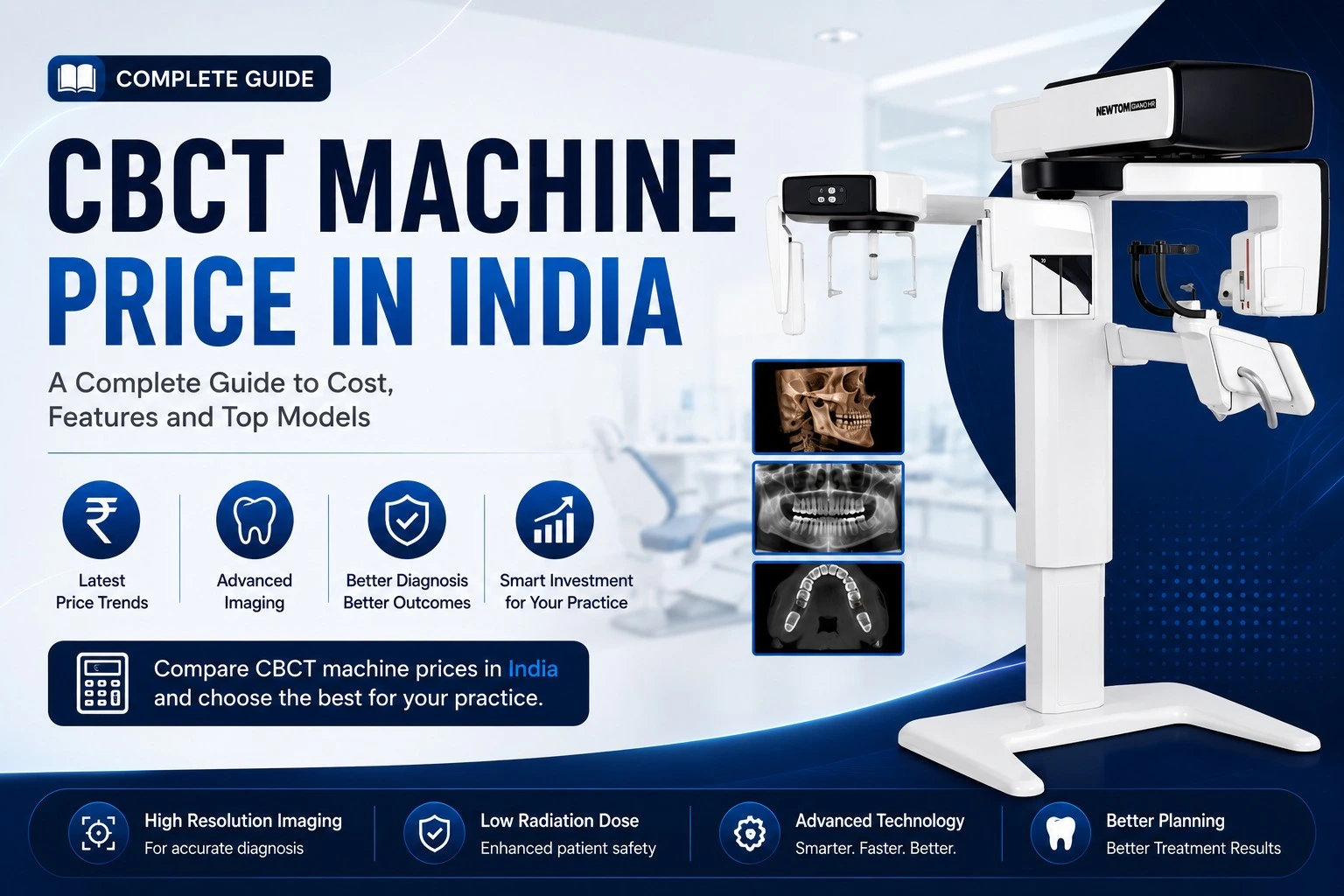
CBCT Machine Price in India 2026 : What You’ll Actually Pay – and What Nobody Tells You Before You Buy
CBCT Machine Price in India 2026
You’ve been researching. You’ve sat through three sales presentations. You’ve got brochures on your desk and WhatsApp messages from six different suppliers. And yet, somehow, you still don’t have a straight answer to the one question that matters most: how much does a dental CBCT machine actually cost in India?
Jump Directly to CBCT Machine Price Table

Reviewed by Dr. Mithun Sahu
Product Head – Radiology | Villa India
Dr. Mithun Sahu holds a BDS degree and brings over two years of clinical experience in oral and maxillofacial radiology. He works closely with dental imaging technologies including CBCT, OPG, and intraoral radiography, helping translate complex radiological findings into clear, actionable treatment plans. At Villa India, he applies this clinical background to support dental practices in making informed, accurate imaging decisions focused on patient safety and diagnostic precision.
Here’s the truth – and it’s the truth that most equipment salespeople won’t lead with. The dental CBCT machine price in India is not a single number. It is a range, a conversation, and – if you don’t go in informed – a trap. Prices in the Indian market span from under ₹10 lakh for entry-level systems to over ₹80 lakh for premium large-FOV CBCT machines. And within that range, the difference between a smart investment and an expensive mistake often comes down to what you know before you walk into the showroom.
This guide is written for dental professionals who are serious about buying a CBCT machine – not for those who want vague price ranges and a brochure. We’ll give you real numbers, the factors that drive them, the hidden costs that catch buyers off-guard, the questions you must ask before signing anything, and a clear framework for understanding which CBCT machine is genuinely worth its price for your specific practice.
“ The dental CBCT machine price in India is not what you pay. It’s what you pay minus what you make – and most buyers never calculate the second part.”
Why Every Serious Dental Practice in India Is Asking About CBCT in 2026
CBCT Machine Price in India 2026 – The Real Numbers
The dental CBCT machine price in India in 2026 varies by machine category, field of view, detector technology, software package, and the after-sales support included. Here is the most accurate price framework available for the Indian market :
CBCT Machine Cost in India: Price Breakdown by Technology & FOV
Price Range (INR)
₹12–20 lakh
₹20–35 lakh
₹35–55 lakh
₹55–80 lakh+
₹25–45 lakh
What You Get / Best For
Small-medium FOV, basic software, limited scan programmes. Best for: First-time buyers, budget-conscious single-chair practices.
Medium FOV, good resolution, reasonable software suite. Best for: Growing practices, implant-focused GDPs.
Large FOV, high resolution, AI features, full software. Best for: Specialist practices, oral surgery, orthodontics.
Largest FOV, highest resolution, 3D ceph, advanced planning tools. Best for: Hospitals, maxillofacial centres, teaching institutions.
2D panoramic + 3D CBCT in one unit. Best for: Practices wanting both modalities, space-efficient clinics.
CBCT vs OPG: Which Imaging System Does Your Clinic Actually Need?
One of the most common questions we receive from Indian dentists is: “Should I invest in a CBCT machine or is a good OPG enough?” The answer depends entirely on the clinical procedures your practice handles. Here is an honest, procedure-by-procedure breakdown:
Key Differences Between CBCT and OPG
Feature
Image type
Bone detail
Implant planning
Nerve mapping
Root fracture detection
Radiation dose
Price range (India)
Best for
OPG (2D Panoramic)
2D flat panoramic
Width only
Limited – estimates only
Approximate
Often missed
Low
₹10 – ₹14 Lakhs
Routine diagnosis
CBCT (3D Imaging)
3D volumetric
Width + height + density
Precise – 1:1 accuracy
Exact canal location
Clearly visible
Low to moderate (with SafeBeam)
₹30 – ₹5 Crore
Implants, endo, ortho, surgery
When an OPG is Sufficient ?
An OPG (orthopantomogram) is ideal if your practice focuses primarily on routine check-ups, basic restorations, and simple extractions. The NewTom GO 2D is one of India’s most popular panoramic systems – combining exceptional image quality with a compact footprint that suits single-chair and small clinics perfectly.
When You Need a CBCT Machine ?
A CBCT machine becomes the clinical standard when your practice involves any of the following:
- Dental implant placement – You cannot accurately plan implant depth, diameter, and angulation from a 2D image alone. CBCT gives you bone height, width, and density with 1:1 volumetric accuracy.
- Complex endodontic cases – Curved canals, missed canals, root fractures, and periapical lesions are frequently missed on 2D X-rays but clearly visible on CBCT.
- Orthodontic treatment planning – Skeletal discrepancies, impacted teeth, and airway analysis all require 3D imaging for accurate assessment.
- Oral and maxillofacial surgery – Third molar removal near the inferior alveolar nerve, jaw surgery, and cyst removal require precise 3D mapping.
- TMJ evaluation – Joint morphology and condylar position cannot be accurately assessed from a panoramic image.
The good news for Indian dentists: NewTom’s range covers both – from the pure 2D GO 2D for routine clinics, to the fully integrated 3D systems for advanced practices.
Why NewTom SafeBeam Technology Sets the Standard for Patient Safety in India ?
NewTom SafeBeam Technology – The Lowest Radiation CBCT Available in India
When Indian dentists evaluate CBCT machine prices, radiation safety is often the concern that makes the final decision. Patients in India are increasingly aware of radiation risks – and rightly so. This is where NewTom’s patented SafeBeam technology provides an advantage that no other CBCT brand on the Indian market can match.
What Is SafeBeam Technology ?
Traditional CBCT machines emit a continuous X-ray beam throughout the entire scan rotation – regardless of whether the beam is actually striking the detector or not. This wastes radiation and exposes the patient unnecessarily.
NewTom’s SafeBeam technology uses a pulsed, adaptive beam that activates only when the X-ray cone is correctly aligned with the detector. The result:
- Up to 50–70% lower radiation dose – compared to conventional CBCT systems
- ALARA-compliant scanning – As Low As Reasonably Achievable
- Paediatric-safe – reduced dose protocols specifically for children
- Adjustable exposure – based on patient size, age, and clinical need
This is why NewTom CBCT systems are the preferred choice for diagnostic centres and academic institutions that perform high volumes of scans – patient safety is not compromised even under daily clinical use.
NewTom Radiation Dose vs Conventional CBCT ?
Scan Type
Small FOV scan
Medium FOV scan
Large FOV scan
Conventional CBCT (approx.)
40–100 µSv
100–200 µSv
200–400 µSv
NewTom with SafeBeam (approx.)
18–40 µSv
45–90 µSv
80–160 µSv
Values are approximate and vary by FOV, exposure setting, and patient anatomy. Consult your NewTom application specialist for protocol-specific dose data.
For Indian dental practices focused on high patient volumes, diagnostic centres, and teaching institutions – SafeBeam technology is not a luxury feature. It is a clinical and ethical responsibility.
Which NewTom CBCT Machine Is Right for Your Specialty ?
Choosing the Best CBCT Machine in India for Your Dental Specialty
The “best CBCT machine in India” is not the same for every dentist. Your clinical focus determines which NewTom model gives you the highest return on investment. Here is a specialty-by-specialty guide:
For General Dentists Setting Up Their First Clinic
Recommended: NewTom GO 3D
If you are a general dentist looking to upgrade from a basic 2D panoramic system to 3D capability, the NewTom GO 3D is your ideal entry point. It combines OPG panoramic imaging with CBCT in a compact, affordable package – perfect for single and double-chair clinics. You get 3D capability for implant referrals and complex endo cases without a full-scale CBCT investment
For Implantologists
Recommended: NewTom GiANO HR or NewTom VGi evo
Implant planning demands the highest possible resolution and 1:1 volumetric accuracy. The NewTom GiANO HR delivers sub-millimetre voxel detail – essential for identifying bone density zones, planning angulation, and fabricating surgical guides. If you also handle orthodontic cases, the VGi evo adds a cephalometric arm to your workflow.
For Endodontists
Recommended: NewTom GiANO HR FullView (small FOV, high resolution mode)
For endodontic diagnosis – particularly second canal detection, root fracture identification, and periapical lesion assessment – you need the smallest voxel size available. The GiANO HR FV in its high-resolution small FOV mode is the gold standard for endo imaging in India. It captures detail that would be completely invisible on any 2D system
For Orthodontists
Recommended: NewTom VGi evo
The VGi evo is the only NewTom model with an integrated cephalometric arm, making it the natural choice for orthodontists who need both panoramic, cephalometric, and 3D CBCT capability from a single machine. Airway analysis, impacted canine localisation, and skeletal assessment – all covered in one unit.
For Oral & Maxillofacial Surgeons and Diagnostic Centres
Recommended: NewTom 5G XL or NewTom 7G
Large field-of-view CBCT is non-negotiable for oral surgeons, maxillofacial surgeons, and diagnostic imaging centres. The 5G XL and 7G offer India’s widest available NewTom FOV – covering the complete craniofacial structure in a single rotation. Ideal for third molar surgery, orthognathic cases, implant-supported full-arch rehabilitation, and ENT-adjacent cases.
CBCT Machine ROI for Indian Dental Clinics: How Quickly Does It Pay Off?
CBCT Machine ROI in India — How Fast Does Your Investment Pay Off??
A common concern among Indian dentists considering a CBCT purchase is: “Will it actually generate enough revenue to justify the cost?” The answer is a clear yes – and the numbers prove it.
Revenue Per CBCT Scan in India
In India, a single CBCT scan is typically charged to patients at:
- Small FOV (endo/implant planning): ₹1,500 – ₹2,500 per scan
- Medium FOV (full jaw): ₹2,500 – ₹4,000 per scan
- Large FOV (craniofacial): ₹4,000 – ₹7,000 per scan
Payback Calculation – NewTom GO 3D Example
Factor
Machine investment
Average scan charge
Scans per week (conservative)
Monthly revenue from scans
Break-even point
Value
₹16 Lakhs (approx.)
₹2,500
6
₹60,000
~27 months
At just 6 scans per week – which is easily achievable even in a medium-volume single-chair clinic – a NewTom GO 3D pays for itself in approximately 2 years. Many Villa India clients report break-even in 18 months or less as referrals grow once the machine is installed.
Additional Revenue CBCT Unlocks
Beyond direct scan charges, a CBCT machine generates significant indirect revenue:
- Increased implant case acceptance – Patients who see their own 3D bone anatomy accept treatment faster
- Referral income – Neighbouring dentists without CBCT send cases to you for scans
- Higher-fee procedures – 3D-planned implants command higher fees than conventional ones
- Reduced complications – Fewer post-surgical issues mean less chair time spent on problem management
AERB Certification for CBCT Machines in India: A Complete Guide
AERB Certification for CBCT Machines in India & Everything You Need to Know
Every dental practice in India that operates any radiographic imaging equipment – including CBCT machines, OPG units, and intraoral X-ray machines – is legally required to obtain certification from the AERB (Atomic Energy Regulatory Board) under the provisions of the Atomic Energy Act, 1962 and the Radiation Protection Rules, 2004.
This is not optional. Operating a CBCT machine in India without valid AERB certification is a legal violation and can result in penalties, equipment seizure, and clinic closure.
What AERB Certification Covers
- Registration of the radiation-generating equipment with AERB
- Radiation Protection Survey (RPS) of the installed X-ray room
- Lead lining or equivalent shielding of walls, floor, and ceiling
- Designation of a Radiation Safety Officer (RSO) for the clinic
- Dosimetry badge monitoring for all staff operating the equipment
- Periodic licence renewal (typically every 3–5 years)
The AERB Certification Process – Step by Step
- Step 1 – Site planning for radiation safety Before installation, a radiation protection survey is conducted to determine the required wall shielding thickness. This depends on the CBCT machine’s output, the room dimensions, and the adjacent spaces.
- Step 2 – Room preparation Walls of the X-ray room must be lined with lead sheets (typically 1.0–2.0 mm Pb equivalent) or equivalent concrete shielding. Doors, viewing windows, and cable entry points must also be shielded appropriately.
- Step 3 – Equipment registration The equipment is registered with AERB through the online SARP (Safety Assessment of Radiation in Practices) portal. Details of the machine, clinic address, RSO, and room layout are submitted.
- Step 4 – Radiation Protection Survey A qualified health physicist conducts the RPS once the machine is installed and the room is shielded. A survey report is generated confirming compliance with AERB dose limits.
- Step 5 – License issuance Upon successful RPS and documentation, AERB issues the license for operation. This must be displayed prominently in the clinic.
- Step 6 – Ongoing compliance Annual dosimetry monitoring, periodic quality assurance of the machine, and licence renewal must be maintained throughout the life of the equipment.
How Villa India Helps With AERB Certification
Villa India provides end-to-end AERB certification support for every NewTom CBCT installation – at no additional charge. Our process includes:
- Pre-installation site survey and shielding recommendations
- Coordination with certified health physicists for the RPS
- Complete documentation preparation and AERB portal submission
- Staff guidance on RSO appointment and dosimetry badge procedures
- Liaison with AERB for any clarifications during the approval process
This means from the day you decide to purchase a NewTom CBCT through Villa India to the day your AERB licence arrives – you are never alone in the process. We have completed hundreds of AERB certifications across India and know the process inside out.
CBCT Machine Financing Options in India
How to Finance a CBCT Machine Purchase in India
The upfront cost of a CBCT machine in India is significant, but it should not be a barrier to upgrading your practice. Several practical financing options are available to Indian dental professionals:
Medical Equipment Loans Leading banks and NBFCs including HDFC Bank, ICICI Bank, Bajaj Finserv, and Tata Capital offer dedicated medical equipment financing for dental equipment. Loan tenures typically range from 24 to 60 months, with competitive interest rates for qualified applicants.
No-Cost EMI Schemes Select equipment purchases through Villa India may be eligible for no-cost EMI arrangements through banking partners – spreading the cost with zero additional interest burden.
Lease / Rental Models For diagnostic centres and corporate dental groups, equipment leasing models allow you to use the CBCT machine while keeping the capital expenditure off your balance sheet. Monthly lease payments are often structured to be covered by scan revenue within the first month of operation.
GST Input Credit If your clinic is GST-registered, the GST component of your CBCT machine purchase (typically 18% on medical equipment) can be claimed as input tax credit – effectively reducing your net cost.
Speak to Villa India’s sales team for current financing options, banking partnerships, and documentation support. We help you structure the purchase in the most financially efficient way for your practice.
What Indian Dentists Say About NewTom CBCT Machines
Real Experiences: Indian Dentists on NewTom CBCT Machines from Villa India
Villa India has installed NewTom CBCT and imaging systems across India – from solo practitioners to diagnostic centres and dental colleges. Here is what our clients say in their own words:

For the past decade, NewTom CBCT has been the backbone of our diagnostic workflow. Its unmatched image clarity and advanced Safe Beam technology allow us to plan complex treatments with absolute confidence. Coupled with the exceptional, reliable service from Villa India, this technology has truly elevated our standard of patient care.

Compared to other CBCT software, NewTom has proven indispensable in myuse. It has superior image quality, precise diagnostics, and seamless workflow integration, enhancing surgical planning and patient care. Reliable and user‑friendly, I confidently recommend NewTom for uncompromising clinical performance.

We have a NewTom CBCT in our Diagnostic Centre in Madurai. This was very prudent decision as the CBCT and software is excellent. I really appreciate the 3600 rotation and Safebeam Technology which is unique to NewTom units.

Being the HOD in OMR Deptt. and teaching radiology for so many years, I have come across a lot of CBCT units and supporting software. The NewTom GIANO from the lot is a power packed machine with which I am running a successful diagnostic centre and I believe I made the best decision.
When we thought of upgrading to a CBCT machine, we had a natural partner in NewTom. We hope to continue our relationship with Villa India and grow together. With the wide range of FOVS and suitable region coverage, NewTom GIANO is the best choice for a diagnostic centre.

I choose “NewTom” CBCT for my diagnostic centre for its image quality & Villa India Service support, in the year 2015. I am very satisfied with my decision.

Being an Oral Radiologist I always dreamt to have my own CBCT center. Later on I came in touch with VILLA INDIA and I was extremely sure about going ahead with my dream. Currently I am working on NewTom GiANO HR Unit which is truly marvelous. The 2D & 3D image quality is just impeccable & goes with the name “Imaging beyond imagination”.
No other CBCT distributor in India can show you this level of consistent, verified satisfaction from qualified oral radiologists and department heads. This is the Villa India difference.
What Actually Drives the Dental CBCT Machine Price in India?
Understanding why CBCT machine prices differ is the only way to evaluate whether a specific system is genuinely worth what a supplier is asking for it. Here are the eight factors that most significantly determine the dental CBCT machine price in India:
Matching FOV to Your Clinical Mix :
- Endodontics focused: Small FOV (5×5 or 8×8 cm) – highest resolution for root canal morphology.
- Implant planning: Medium FOV (10×10 or 12×10 cm) – covers full arch with adequate detail.
- Orthodontics + surgery: Large FOV (16×13 cm or greater) – full skull for cephalometric and surgical planning.
- General practice: Medium FOV with ceph option – covers 80% of everyday clinical needs.
The Hidden Cost of Uncertified CBCT Machines in India
The Indian market contains a significant number of CBCT machines sold at very low prices that are not CE certified, have no AERB documentation support, and come with no meaningful after-sales service. These machines may produce images. They may function initially. But they create serious regulatory exposure under AERB radiation safety rules, offer no manufacturer warranty, and leave the buyer completely unsupported when components fail.
How Field of View (FOV) Directly Impacts CBCT Machine Cost in India
When researching a cbct machine in india, many dentists wonder why one machine costs ₹18 Lakhs while another costs ₹45 Lakhs. The biggest factor driving this price difference is the Field of View (FOV) – which determines the 3D volume captured in a single scan.
Small FOV : Focuses on 1 to 3 teeth. Requires smaller flat-panel detectors, making it the most budget-friendly option for endodontists and general dentists.
Medium FOV : Captures both upper and lower arches in a single exposure. This is the sweet spot for implantologist clinics looking for an optimal cbct machine price in india vs. clinical utility ratio.
Large FOV : Covers the entire craniofacial structure, including sinus, TMJ, and airway passages. High-end detectors and advanced reconstruction software significantly increase the overall cbct machine investment.
AERB Approval & Radiation Safety: Why It Matters Before Purchasing
Buying a dental cbct machine in India isn’t just about paying the equipment supplier; you must also comply with mandatory government radiation safety protocols managed by the Atomic Energy Regulatory Board (AERB).
Critical AERB Requirements
Type Approval: Always ensure that the specific cbct machine in india you choose has a valid AERB Type Approval certificate issued to the manufacturer/importer.
e-LORA Registration: Your dental facility must be registered on the AERB e-LORA portal before installing the diagnostic unit.
Room Layout & Lead Shielding: The imaging room requires certified lead-lined walls (or equivalent thick concrete), lead glass windows, and a lead door to pass the radiation protection inspection.
Quality Assurance (QA) Testing: Periodic QA testing by an AERB-empanelled expert is mandatory to ensure radiation dosage remains within safe diagnostic limits.
Hidden & Additional Costs Checklist: Beyond the Sticker Price
When evaluating the total cbct machine price in india, the initial quotation from the vendor rarely covers 100% of your actual expenditure. Below is a checklist of hidden costs you must budget for:
Software Licensing & Upgrades:
Check if the 3D viewing, implant planning, and DICOM software come with a lifetime license or require annual subscription fees.
Site Preparation & Shielding:
Construction costs for lead-lined doors, lead glass, and proper wall thickness usually cost an extra ₹50,000 – ₹1.5 Lakhs.
Power Infrastructure:
High-frequency 3D imaging requires dedicated online UPS systems (usually 3KVA–5KVA) and heavy-duty stabilizers to protect sensitive flat-panel detectors.
AMC / CMC Post-Warranty:
Annual Maintenance Contracts (AMC) or Comprehensive Maintenance Contracts (CMC) typically cost 5% to 8% of the total machine cost annually after the primary warranty expires.
AERB Compliance & QA Fees:
Documentation, layout approval processing, and QA testing fees incur additional operational costs.
Customs & Freight (If applicable):
Confirm whether the quoted price includes doorstep delivery, unloading, installation, and GST (typically 12% to 18% depending on tax classifications).
The 7 Most Expensive Mistakes Indian Dentists Make When Buying a CBCT Machine
Mistake 1: Choosing on Price Instead of Clinical Fit
The cheapest CBCT machine is not the right CBCT machine if its FOV doesn’t match your procedures or its software can’t support your workflows. An undersized machine you outgrow in two years costs more than a correctly specified machine you use confidently for fifteen.
Mistake 2: Ignoring AERB Compliance Requirements
Many buyers discover only after purchase that their room requires structural shielding modifications, that AERB registration requires documents their supplier cannot provide, or that the machine they purchased is not technically registerable. This can delay your machine going live by months – at significant financial cost.
Mistake 3: Not Calculating ROI Before Purchasing
Every dental CBCT machine purchase should be evaluated as a business decision, not just a clinical one. A mid-range CBCT machine at ₹35 lakh, scanning 25 patients per month at ₹3,000 per scan, generates ₹75,000 per month – recovering the investment in approximately 39 months purely from scan revenue. When combined with increased case acceptance and reduced referrals, the real ROI timeline is typically 18 to 24 months.
Mistake 4: Buying a Large FOV Machine When a Medium FOV Would Serve
More FOV is not always better. A practice focused on implants and endodontics may never use the large FOV capability of a premium CBCT machine – paying ₹20–30 lakh more for features that sit unused. Match your FOV to your actual clinical volume and case mix.
Mistake 5: Underestimating Software Costs
The machine price rarely includes advanced planning software. Implant planning platforms, orthodontic analysis tools, and surgical guide design software are often sold separately – adding ₹2 to ₹8 lakh to the real CBCT machine cost in India. Always ask for an all-inclusive quote including software before comparing prices between suppliers.
Mistake 6: Not Verifying Genuine Dealer & Distributor Status
Every reputable CBCT manufacturer has an authorised dealer network in India. Purchasing through an unauthorised reseller voids manufacturer warranty, may provide machines with non-original components, and leaves you without manufacturer support for software updates or hardware repairs. Always verify authorised dealer status directly with the manufacturer before purchasing.
Mistake 7: Skipping the Live Clinical Demonstration
No brochure accurately represents scan speed, image quality, or software usability in a real clinical environment. Before purchasing any CBCT machine, insist on a live clinical demonstration – either at the dealer’s showroom or, ideally, at a reference site where the machine is already in active use. This single step eliminates the most common source of post-purchase disappointment.
Why NewTom Offers the Best Value CBCT Machine in India Across Every Price Point
Villa India supplies the complete NewTom CBCT machine range – and we are frequently asked why NewTom commands the prices it does in the Indian market when cheaper alternatives exist. The answer lies in three things that cannot be seen in a brochure but are felt in every scan, every day, for the life of the machine.
Italian Manufacturing — What It Actually Means
NewTom CBCT machines are designed and built in Verona, Italy – and Italian manufacturing heritage in precision medical devices is not marketing language. It means tighter component tolerances, more rigorous quality control, longer component service life, and consistent image quality from the first scan to the ten-thousandth. For a machine you will use daily for a decade, this is not a small difference.
SafeBeam —The Technology That Protects Your Patients
NewTom’s SafeBeam automatic dose modulation technology automatically adjusts the radiation dose per patient – making every NewTom CBCT machine the lowest-dose system in its class. For a clinical and ethical commitment to patient safety, this technology is the standard every other CBCT machine should be measured against.
NNT Software — No Hidden Software Costs
Every NewTom CBCT machine includes NNT – a comprehensive dental imaging solution software platform covering implant planning, orthodontic analysis, airway measurement, endodontic assessment, surgical planning, and 3D cephalometrics. Unlike many competing systems, NNT does not require expensive third-party add-ons for standard clinical workflows. The price you pay for a NewTom CBCT machine includes the software you actually need to use it clinically from day one.
NewTom CBCT Machines Available in India Through Villa India
- NewTom GO 3D: Entry-level CBCT machine – ideal for general practices entering 3D imaging.
- NewTom VG-One: OPG + CBCT combined – two modalities, one footprint, accessible dental CBCT machine price.
- NewTom GiANO HR: High-resolution specialist CBCT – 50µm voxel, 3D Ceph, premium image quality.
- NewTom GiANO HR FullView: Sharpest-resolution specialist CBCT – 50µm voxel, 3D Ceph, premium image quality. with Advanced IGZO Flat Panel Sensor.
- NewTom VGi evo: Advanced high-volume CBCT – large FOV, AI-assisted analysis tools.
- NewTom 5G XL: Extra-large FOV CBCT – full skull imaging for hospitals and maxillofacial centres.
- NewTom 7G: Most advanced NewTom CBCT machine – Dual Energy, full-capability premium system.
Frequently Asked Questions – Dental CBCT Machine Price in India
Ready to Invest in the Best CBCT Machine in India?
Get the Best CBCT Machine in India – Directly from India’s Authorised NewTom Distributor
Villa India has been India’s authorised NewTom partner for over three decades. When you choose a NewTom CBCT machine through Villa India, you are not just buying world-class imaging technology – you are investing in a complete support ecosystem that covers:
✅ Genuine NewTom CBCT machine with manufacturer warranty ✅ Site planning and radiation room consultation at no extra cost ✅ Professional installation by certified technical engineers ✅ Complete AERB certification assistance – end to end ✅ Clinical application training for your team ✅ PAN India after-sales service network ✅ Assistance with financing and EMI structuring ✅ Ongoing software updates and technical support
Whether you are a general dentist taking your first step into 3D imaging, an implantologist building a premium practice, or a diagnostic centre investing in large-FOV capability – Villa India has the right NewTom CBCT machine for your clinical goals and budget.
📞 Call us: 1800 202 1960 (Toll Free) 📧 Email: welcome@villaindia.com 🌐 Website: villaindia.com 📍 Naraina Industrial Area Phase 1, New Delhi — 110028
Leave a Reply